Snake Bite First Aid Kit for Camping: What You Need to Carry
Last updated: February 2026
There is a common assumption among campers that snake bites are rare enough to ignore. The statistics say otherwise. It is believed that up to 1,500 definite or suspected snakebites occur in Australia each year, of which about 200 are serious enough to warrant antivenom therapy. Snake activity peaks during the warmer months — precisely when most Australians are out camping, hiking, and exploring the bush. If you are planning a trip into the outdoors and your first aid kit doesn't include dedicated snake bite supplies, you have a serious gap in your safety preparation.
This article will walk you through exactly what you need to carry, why standard first aid kits often fall short, and how to use a snake bite kit correctly when it matters most.
Snake Bite Risks in Australia: Why Campers Can't Afford to Ignore Them
Australia is unique among continents in one particularly unsettling way: venomous snakes constitute the majority of species. The country is home to over 100 venomous snake species, though only around a dozen carry venom potent enough to kill a human. That dozen is more than enough to demand respect.
The brown snakes, death adders, mulga snakes, taipans, and tiger snakes are the five groups that inflict virtually all reported snakebites. Of these, the eastern brown snake is by far the most dangerous in practice — not because it has the most potent venom, but because it is widespread, common in both rural and urban environments, and easy to mistake for a harmless species due to its plain colouring.
Camping raises the risk profile considerably. When you're spending time in the bush — setting up camp, gathering firewood, walking trails, or simply moving through tall grass — the chance of an encounter increases. Activities like hiking, gardening, farming, and camping in snake-prone areas increase the risk of encounters. And when you're remote, the consequences of an encounter become far more serious. The nearest hospital could be hours away. Every minute of delay in applying correct first aid matters.
The good news is that each year in Australia, between 1 to 4 people die from snake bites. That low fatality rate is not luck — it's the result of effective first aid techniques and widely available antivenom. But both of those things require you to act correctly and quickly. A snake bite kit is how you make that possible in the field.
Why Standard First Aid Kits Aren't Always Enough
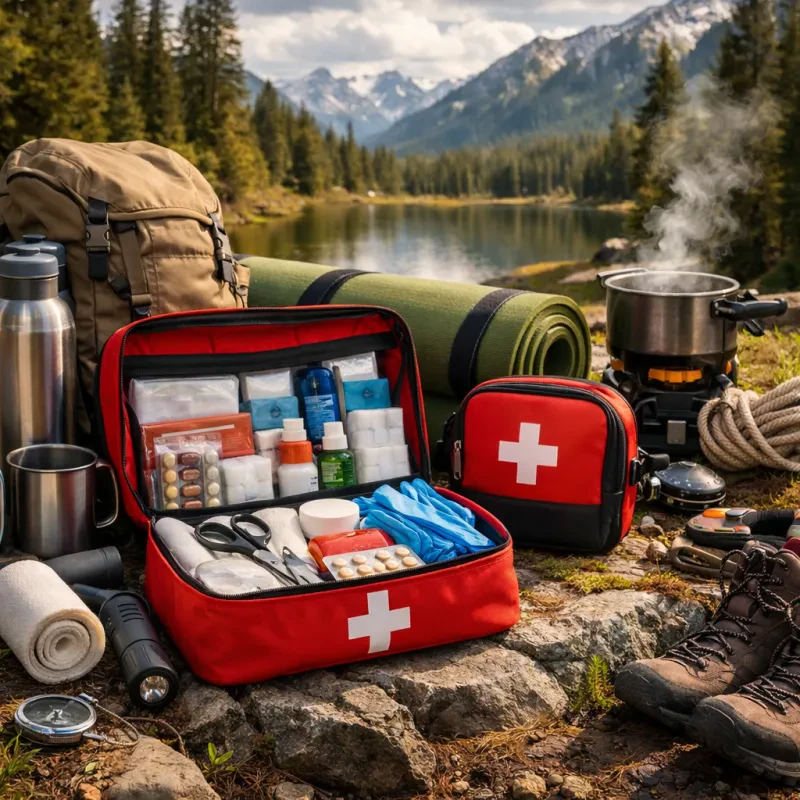
A general-purpose camping first aid kit is designed to handle the broad range of injuries you might sustain outdoors: cuts, scrapes, blisters, sprains, minor burns, and insect stings. It will contain adhesive bandages, gauze, antiseptic, maybe an elastic bandage or two. For most camping injuries, that's perfectly adequate.
But snake bite first aid is a fundamentally different kind of response. It requires specific equipment, applied in a specific way, to a specific standard of pressure. A generic elastic bandage from a basic kit might not be wide enough, firm enough, or long enough to cover an entire limb. A kit without a splint gives you no way to immobilise the affected area. And a kit without a clear, step-by-step guide for envenomation treatment is almost useless in the panicked moments after a bite.
The pressure required to effectively slow venom spread is precise. The current evidence base suggests a minimum pressure of 55 mmHg for bites to the legs, and 40 mmHg for bites to hands or arms. Purpose-built snake bite bandages — particularly those with pressure indicator markings — take the guesswork out of this. Without them, most people will either wrap too loosely (ineffective) or too tightly (dangerous). A dedicated snake bite kit solves this problem before it starts.
Essential Items for a Snake Bite Kit
If you're assembling your own kit or evaluating one off the shelf, these are the items that must be included for it to be genuinely useful in an Australian envenomation emergency.
Heavy-weight compression bandages are the most critical item. You need at least two, and ideally three. These should be broad elastic bandages — 10 cm wide is the standard — long enough to wrap an entire limb from fingers or toes to the shoulder or groin. Bandages with built-in pressure indicators (sometimes called "indicator bandages" or "SMART bandages") are significantly better than plain crepe bandages because they show you visually whether you've achieved the correct compression.
A rigid splint is the second essential. Once the compression bandage is applied, the limb must be immobilised to prevent the pumping action of skeletal muscles from pushing venom deeper into the lymphatic system. A purpose-built splint is ideal, but in a true emergency, a sturdy stick or piece of timber will work. The splint should cover the joints on either side of the bite.
A triangular bandage serves as a sling for upper-limb bites and provides additional immobilisation. It's lightweight and takes up almost no space in a kit.
A bite-site marker — a pen or permanent marker — allows you to circle the area of the bite on the outside of the bandage. This helps medical staff identify the location quickly when you reach a hospital, and also lets you track whether swelling is progressing.
An emergency treatment guide specific to envenomation is essential, especially for anyone without formal first aid training. In a high-stress situation, having clear, numbered steps in front of you is far more reliable than trying to recall instructions from memory.
How Compression Bandages Are Used: The Pressure Immobilisation Technique
The Pressure Immobilisation Technique — universally known as PIT — is the gold-standard first aid response to snake bites in Australia. It was developed in the 1970s by Australian medical researcher Struan Sutherland and remains the recommended approach endorsed by ANZCOR (the Australian and New Zealand Committee on Resuscitation).
The principle is straightforward: venom is spread via the lymph system, so applying a bandage slows the movement of venom from the bite site through the lymphatic system and into the blood circulation. Immobilisation of the limb also slows lymphatic drainage. Research has shown that when PIT is applied correctly and maintained, very little venom reaches the bloodstream — even after several hours.
Here is how it works in practice:
Step 1 — Call for help. Call Triple Zero (000) immediately. Do not wait to see if symptoms develop. All snake bites in Australia must be treated as potentially life-threatening.
Step 2 — Keep the person still. Keep the bitten limb, and the patient, still. Movement pumps venom through the lymphatic system. Reassure the person and have them lie down.
Step 3 — Remove constricting items. Take off rings, bracelets, watches, or ankle bands from the bitten limb before bandaging begins. Swelling can make these dangerous to remove later.
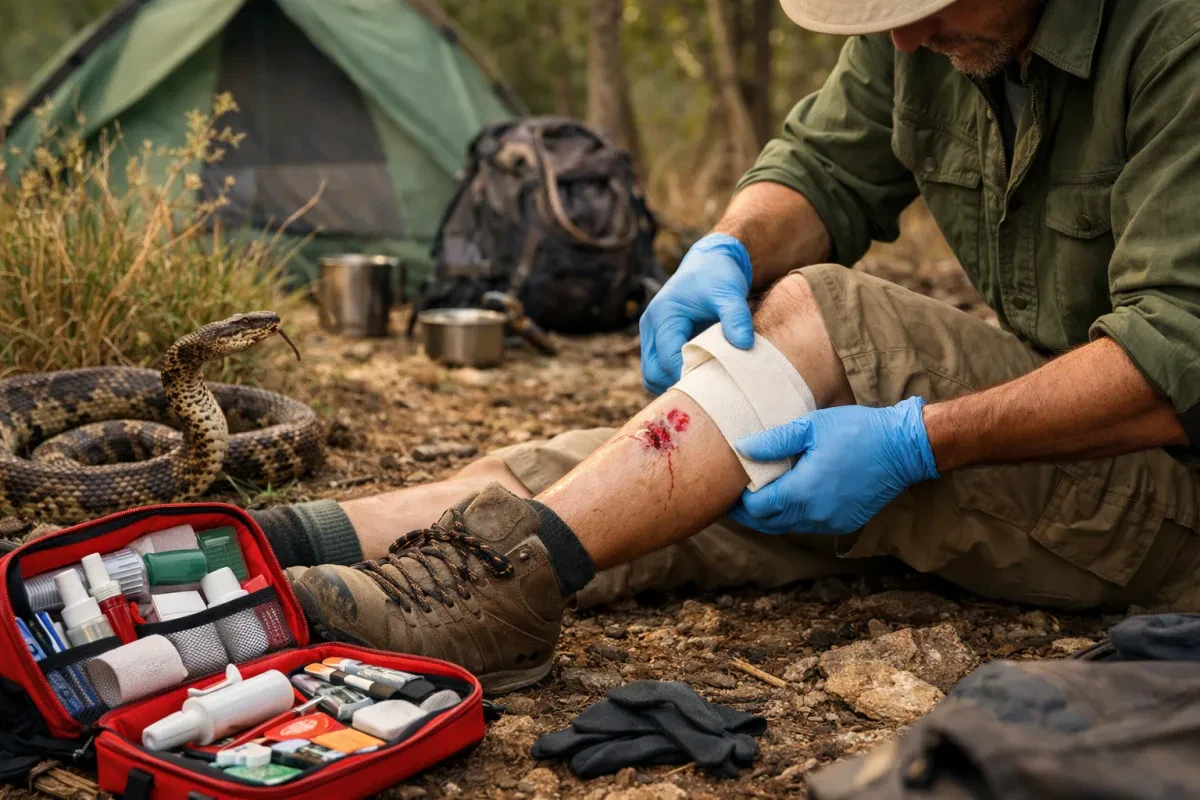
Step 4 — Apply the compression bandage. Regardless of where on the limb the bite has occurred, commence bandaging from just above the toes (leave these uncovered so that blood flow to the nail beds can be monitored). Wrap upward toward the body, covering the bite site as you go. The bandage should be as tight as you would apply to a sprained ankle. If you have indicator bandages, follow the markings to achieve the correct pressure.
Step 5 — Immobilise the limb. Apply the splint over the bandage to keep the limb rigid. For leg bites, you can strap the injured leg to the uninjured one. For arm bites, use a sling.
Step 6 — Mark the bite site. Use a pen to circle the bite location on the outside of the bandage.
Step 7 — Monitor and wait. Stay with the person. Watch their breathing and level of consciousness. If the bandages and splint have been applied correctly, they will be comfortable and may be left in place for several hours. They should not be taken off until the patient has reached medical care.
What NOT to Do After a Snake Bite
Myths and outdated advice about snake bite treatment are remarkably persistent, and acting on them can make a dangerous situation worse. Here is what to avoid.
Do not cut the bite or try to suck out venom. This is one of the most enduring myths in first aid. Contrary to popular myths, these methods are completely ineffective and may also introduce infection. Cutting the skin can cause serious tissue damage and does nothing to stop venom absorption.
Do not wash the bite site. This one catches people off guard. Venom left on the skin can aid in identifying the snake species, and thus the correct antivenom. Hospitals can use venom detection tests on skin residue to determine which antivenom to administer. Washing it away removes that information.
Do not use a tourniquet. Arterial tourniquets that cut off circulation to the limb are potentially dangerous and are not recommended for any type of bite or sting in Australia. A tourniquet restricts blood flow, but most snake venoms travel via the lymphatic system, not the bloodstream. Cutting off blood flow risks causing tissue death in the limb.
Do not try to catch or kill the snake. It is strongly recommended that no attempts be made to kill the snake due to the risk of multiple bites or another person being bitten. Identification is not necessary for treatment — hospitals can determine the snake species and correct antivenom through blood tests and clinical signs alone.
Do not remove the bandages before reaching a hospital. If prematurely removed, the venom held back by the PIT can quickly surge through the body. The treating doctor will decide when it is safe to remove them, once antivenom and resuscitation equipment are standing by.
Choosing a Kit That Includes Snake Bite Coverage
When shopping for a camping first aid kit with snake bite capability, there are two main approaches: buying a standalone snake bite kit to carry alongside (or inside) your general first aid kit, or choosing a comprehensive camping kit that already includes envenomation supplies built in.
Standalone snake bite kits are the more portable option. The best ones weigh well under 600 grams and are compact enough to clip onto a belt, attach to a backpack, or tuck into a jacket pocket. Look for kits that include at least two heavy-weight compression bandages with pressure indicators, a splint, and a treatment guide. These kits are purpose-built for a single, specific emergency, which means everything inside is directly relevant and easy to find under pressure.
Comprehensive camping kits with snake bite modules suit campers who want a single, all-in-one solution. The best of these use a colour-coded or modular system so that the envenomation supplies are clearly separated and instantly identifiable — you don't want to be rummaging through wound care supplies looking for a compression bandage in an emergency. Kits built from durable, water-resistant materials (600D Oxford polyester is a common and reliable standard) will hold up in the harsh Australian outdoors without degrading.
Regardless of which format you choose, the quality of the compression bandages is the single most important factor. Bandages developed in consultation with Australian venom experts, particularly those that meet or exceed the pressure recommendations from bodies like the Australian Venom Council, will give you the best chance of applying PIT effectively. A kit with impressive packaging but generic bandages is not worth the money.
For a comprehensive camping first aid kit that covers both everyday injuries and envenomation emergencies, browse our full first aid kit range. For a top-rated camping kit that includes dedicated snake bite coverage, see our recommended camping first aid kit.
Frequently Asked Questions
Is a snake bite kit necessary if I'm only camping for one night? Yes. Snake encounters don't follow camping itineraries. A single overnight trip at a bush campsite carries the same per-encounter risk as a week-long expedition. A dedicated snake bite kit is lightweight enough — typically under 600 grams — that there is genuinely no reason to leave it behind, regardless of trip length.
Can I use a regular elastic bandage instead of a purpose-built snake bite bandage? In an emergency, any firm bandage is better than nothing. However, purpose-built snake bite bandages are significantly more effective because they are the correct width, length, and elasticity for achieving the required compression pressure. Indicator bandages remove the guesswork entirely. If you're going to carry a kit, carry the right bandages.
Do I need to identify the snake to get treatment? No. Hospitals in Australia can identify the venom through blood tests and clinical signs. Do not waste time or risk additional bites trying to catch or photograph the snake. Apply PIT, call 000, and focus on getting to medical care.
Should I carry a snake bite kit even in urban or suburban areas? It's a reasonable precaution, particularly in regional towns or areas bordering bushland. Over half of snake bite deaths in Australia have occurred at or near people's homes. A small belt-mounted kit adds negligible weight and provides meaningful coverage.
How do I know if my snake bite kit is still good to use? Check the compression bandages for damage, creasing, or loss of elasticity before each trip. Replace any bandages that have been used or show signs of wear. The splint and marker pen have no expiry, but the bandages do degrade over time, particularly if exposed to heat or UV. A full check at the start of each outdoor season is good practice.
If you're heading into the bush this season, make sure your kit is ready before you leave the driveway. The bush deserves your respect — and your preparation.